Preparing for a Digital Audit Workforce: Lessons Learned from Applying Agentic AI at the Swiss Federal Audit Office
Authors: Orlando Willig (orlando.willig@efk.admin.ch) and Marco Schreyer (marco.schreyer@efk.admin.ch), Swiss Federal Audit Office (SFAO), Bern, Switzerland
1. A Technological Shift for Public Audits
The integration of artificial intelligence (AI) in the public-sector has reached a point at which Supreme Audit Institutions (SAIs) can no longer treat it as a distant or experimental matter. Emerging applications of agentic AI are beginning to reshape the work of professional knowledge services, including auditing. The pace of this development, driven both by private-sector commercial adoption and by the rapid evolution of open technical standards, makes technology relevant for public auditing today rather than at some point in the future.
Recent signals from the private sector illustrate the scale of the shift: the “Big Four” accounting firms estimate that AI agents will contribute between 20 and 30 percent of a typical financial audit by 20291. While SAIs operate under fundamentally different mandates, the underlying technological curve is a shared one – and a redistribution of this magnitude would substantially reshape the composition of audit work.
This article draws on early experiences of the Swiss Federal Audit Office (SFAO) in deploying agentic AI in audit contexts, including performance audits. It identifies considerations that warrant institutional attention regardless of current technical maturity, and it sketches the direction in which the underlying architecture is evolving. Its central proposition is that SAIs cannot understand agentic AI from the outside. Practical engagement – through small, well-scoped projects under appropriate data protection and governance arrangements – is the surest way to build the institutional knowledge required to use the technology responsibly and on the SAI’s own terms.
2. From Chatbot to Agent: A Structural Shift
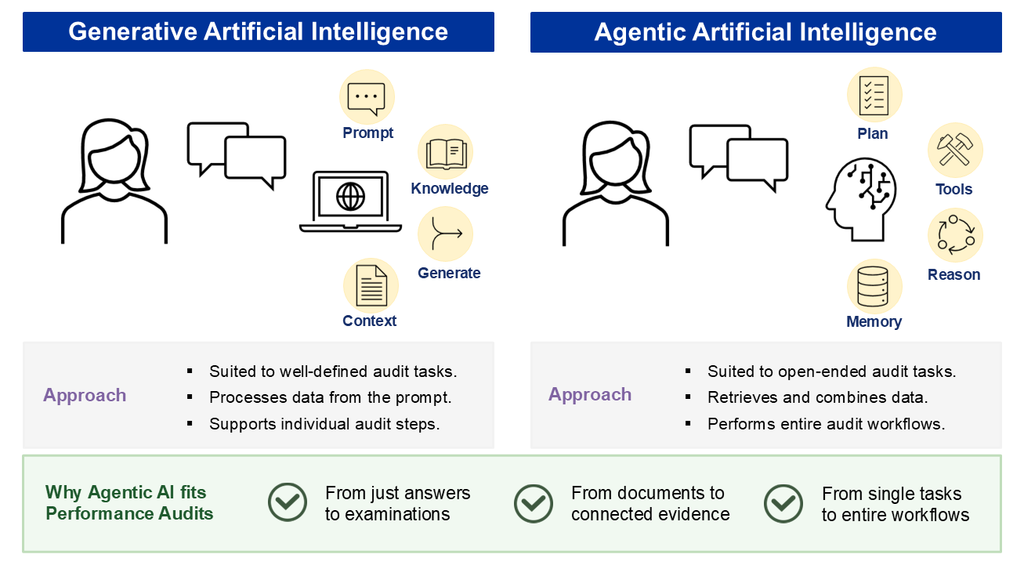
The distinction between generative and agentic artificial intelligence is structural, not merely gradual. Where generative AI responds to prompts, agentic systems operate autonomously toward defined goals over extended periods2 – combining tool use, memory, and planning to decompose complex tasks, access external data sources, and refine their outputs based on intermediate results.3 4 5 6 7 For performance auditing, this shift is particularly significant: performance audits are inherently iterative, multi-source, and judgment-based.8 Requiring the kind of cross-system retrieval and evidence synthesis9 that agentic architectures are specifically designed to handle (see Figure 1).
3. Early Experiences at the Swiss Federal Audit Office
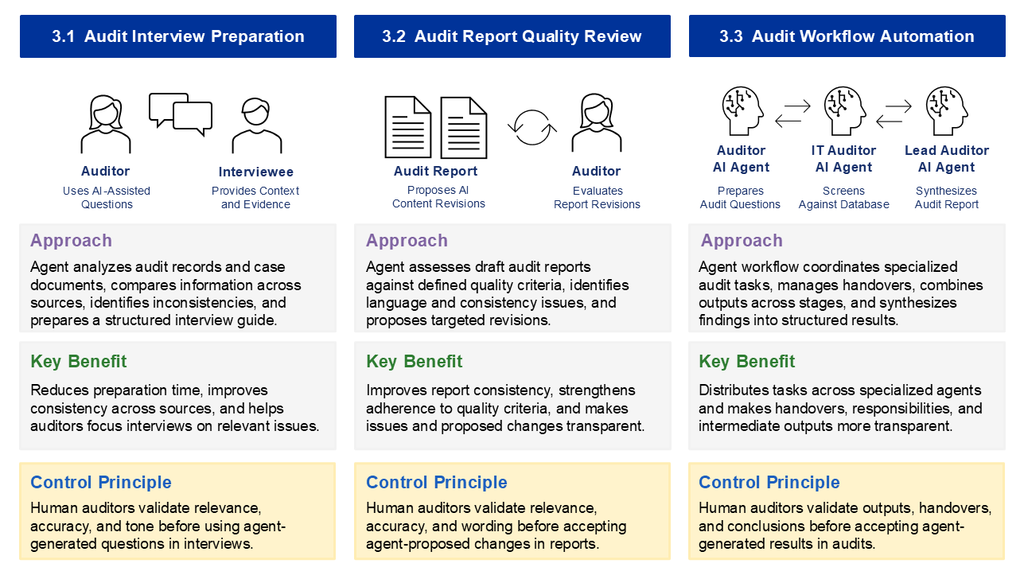
At the SFAO, early work with agentic AI has focused on concrete audit situations rather than abstract experimentation. The aim has been to understand how agents perform when applied to core audit tasks: preparing interviews, reviewing reports, comparing information, and structuring findings. Three strands are particularly instructive: interview preparation, quality assurance of audit reports, and multi-agent collaboration in audit workflows (see also figure 2).
3.1 Agentic AI for Interview Preparation
A first prototype focused on supporting preparation for a follow-up meeting on an audit mandate. Using an agentic setup connected to an audit database and a set of case documents, the agent reviewed materials across both sources, compared information from different parts of the audit file, identified inconsistencies, and produced a structured interview guide with specific points for clarification and follow-up. The prototype demonstrated the value of agentic AI for focused synthesis across heterogeneous audit materials. A task that would typically require several hours of manual review could be completed in minutes, while the auditor remained responsible for assessing relevance, accuracy, and tone. The lesson was not that the agent could replace audit preparation, but that it could accelerate retrieval, comparison, and structuring in support of human professional judgment.
3.2 Agentic AI for Audit Report Quality Assurance
A second prototype focuses on the quality assurance of audit reports. It supports the human final review of report drafts through a structured, AI-assisted workflow from preliminary review to final approval. The system checks language, structure, consistency, and editorial quality against defined review stages, SFAO-specific drafting guidelines, and applicable federal guidelines. The prototype illustrates how agentic AI can contribute to a part of audit work that is essential but time-consuming and often unevenly documented. By comparing the original text with proposed revisions and documenting review steps, applied rules, open points, and approval status, it creates greater transparency in the quality-assurance process. The lesson is that agentic AI can help apply institutional standards more consistently, provided that human reviewers retain responsibility for accepting, rejecting, or adapting proposed changes.
3.3 Agentic AI for Multi-Agent Audit Workflows
A third prototype explored how agentic AI can be structured not only as a single system but also as a team of collaborating agents. In this proof of concept, three agents were deployed in sequence, each assuming a distinct audit role: an Auditor agent to identify and extract relevant entities from a source document, an IT Auditor agent to screen those entities against an external reference database, and a Lead Auditor agent to synthesize the findings into a structured audit report. The prototype demonstrated that a division of labor between agents can mirror the division of responsibility within a human audit team. No single agent performed the full task; each built on the output of the previous one, creating handover points that can serve as checkpoints for human review.10 The lesson was architectural: complex audit tasks may be decomposed into role-specific steps, making agentic workflows more transparent, governable, and compatible with human oversight.
In parallel, agents have been tested at the SFAO on a range of internal tasks. The value of these experiments lies less in any individual output than in the breadth of hands-on exposure they provide – both for building institutional familiarity with the technology and for identifying where it adds value in practice.
4. Challenges and Considerations for SAIs
The experience described above raises a set of considerations that every SAI should examine before scaling agentic AI into routine practice. The transition from computer-assisted audit techniques (CAATs) to agentic AI introduces new forms of technical and organizational reliance: agents combine retrieval, validation, extraction, and analytical capabilities, and operate them with a degree of autonomy that earlier tools did not possess. Five interrelated challenges are particularly relevant.11
- Data quality: Reliable outputs depend on reliable inputs; SAIs therefore need complete, consistent, and machine-readable data before agentic systems can be used meaningfully.12
- Traceability and governance: Audit evidence must remain traceable, which requires logging of prompts, model versions, tool invocations, retrieved sources, intermediate outputs, and human review steps.13 14 15 16 17
- Competencies: Auditors will need to learn not only how to use agentic systems, but how to delegate tasks to them, question their outputs, and orchestrate agent-supported workflows.18 19
- Institutional readiness: Effective deployment requires more than a technical pilot; it depends on infrastructure, data protection arrangements, specialized expertise, governance frameworks, and sustainable operational support.20
- Bias and impartiality: Because AI systems may reflect distortions in training data, source materials, or design choices, SAIs must embed human validation and professional skepticism into agent-supported audit work.21 22
Taken together, these challenges do not argue against the use of agentic AI; they argue for its careful and deliberate implementation – one that is consistent with the institution’s mandate, governance structures, and operational conditions.
5. Looking Ahead: Where Technology Is Going
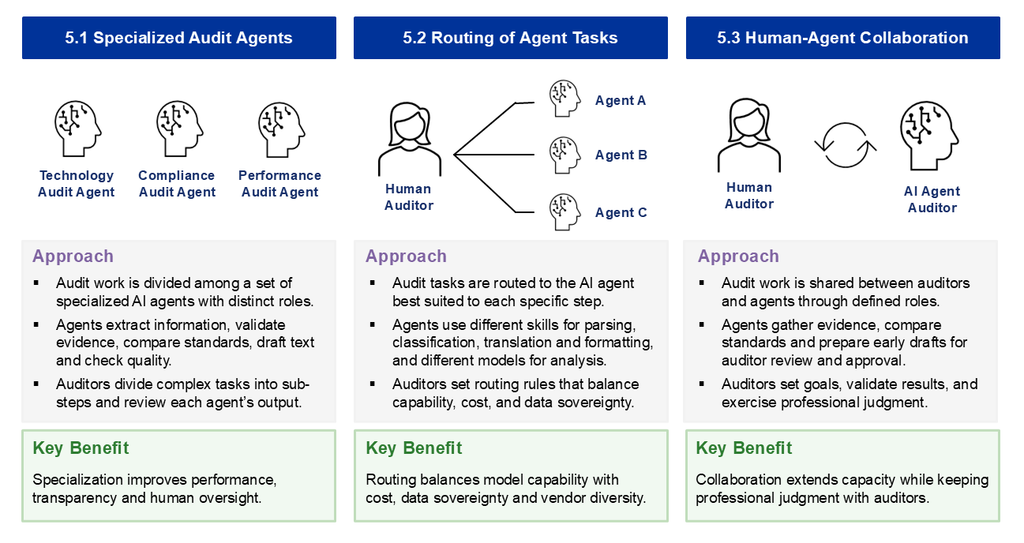
“Audits are not dying yet, but they do need to adapt to the digital age,” the International Accounting and Assurance Standards Board (IAASB) noted in its 2016 reflection on the future of audit. For SAIs, the rise of agentic AI gives this statement renewed practical significance. The challenges discussed above arise within an architecture that is itself still evolving, and three trends taking shape during 2026 will define the next phase of adoption (see also figure 3).
5.1 Agentic Audit Task Specialization
Current agentic AI deployments often still rely on a single agent, but the next step is likely to be greater task specialization. Dedicated agents for extraction, validation, norm comparison, drafting, and quality review can divide complex audit work into clearer and more governable steps. For SAIs, the lesson is that specialization can improve not only technical performance, but also transparency, responsibility, and human review.
5.2 Agentic Audit Task Routing
A second trend is the routing of audit tasks to the most appropriate AI agent. Complex reasoning may require more capable models, while parsing, classification, translation, or formatting may be handled by smaller or more specialized models. For SAIs, the lesson is that task routing can turn cost, data-sovereignty, and vendor-diversification requirements into deliberate architectural choices.
5.3 Agentic Audit Workforce
These architectural shifts point toward an audit workforce in which humans and agents operate in structured collaboration. Agents may increasingly support evidence gathering, standard comparisons, and initial drafting, while auditors focus on objectives, validation, stakeholder dialogue, and professional judgment. For SAIs, the lesson is that the central question is not whether agentic AI will replace auditors, but how auditors can use it responsibly and on their own terms.23
Taken together, these trends suggest that the future of audit will not be defined by replacing auditors, but by redesigning how auditors and agents work together. The relevant question for each SAI is where, in relation to that trajectory, it chooses to position itself.
6. Conclusion
Agentic AI is moving fast from research prototype to operational practice. The SFAO’s early experiments yield three lessons of broader relevance: practical engagement is the only reliable path to institutional understanding; small and well-scoped projects are a viable entry point whose value lies less in immediate output than in the institutional familiarity they build; and because the challenges agentic AI poses – around traceability, competencies, and oversight – are shared across SAIs, addressing them in isolation is inefficient (see figure 4).
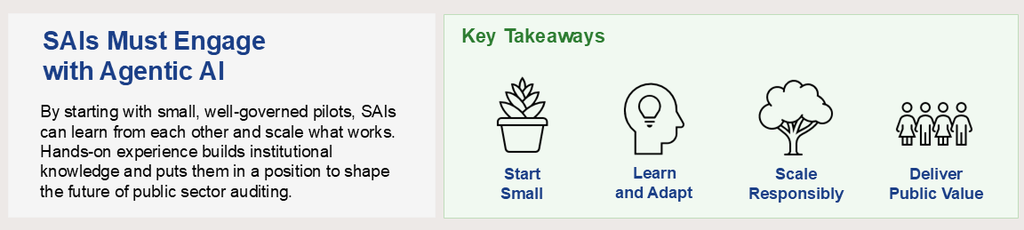
This last point argues for a structural response. A dedicated INTOSAI-level forum for the pragmatic exchange of experience on agentic AI would accelerate the collective learning curve of member institutions far more effectively than parallel isolated efforts. The opportunity to shape the role of this technology in public auditing from inside the profession itself is open at this moment, and acting upon it is a matter of institutional responsibility.
Footnotes
- Maurer, M. (2026). “In This Critical Part of Audits, the Accountant’s Role Is Shrinking Fast.” Wall Street Journal, April 2026. https://www.wsj.com/cfo-journal/in-this-critical-part-of-audits-the-accountants-role-is-shrinking-fast-69c7f2bc. ↩︎
- Russell, S., & Norvig, P. (2021). Artificial Intelligence: A Modern Approach (Global Edition). Pearson Higher Education. ↩︎
- NVIDIA. (2025). AI Agents. NVIDIA Glossary. Retrieved November 24, 2025, from https://www.nvidia.com/en-us/glossary/ai-agents/. ↩︎
- Masterman, T., Besen, S., Sawtell, M., & Chao, A. (2024). The Landscape of Emerging AI Agent Architectures for Reasoning, Planning, and Tool Calling: A Survey. arXiv preprint arXiv:2404.11584. ↩︎
- Wei, J., Bosma, M., Zhao, V. Y., Guu, K., Yu, A. W., Lester, B., & Le, Q. V. (2021). Fine-tuned Language Models Are Zero-Shot Learners. arXiv preprint arXiv:2109.01652 ↩︎
- Lewis, P., Perez, E., Piktus, A., Petroni, F., Karpukhin, V., Goyal, N., Küttler, H., Lewis, M., Yih, W., Rocktäschel, T., et al. (2020). Retrieval-Augmented Generation for Knowledge-Intensive NLP Tasks. Advances in Neural Information Processing Systems, 33, 9459–9474. ↩︎
- Huang, X., Liu, W., Chen, X., Wang, X., Wang, H., Lian, D., & Chen, E. (2024). Understanding the Planning of LLM Agents: A Survey. arXiv preprint arXiv:2402.02716. ↩︎
- INTOSAI. (2019). ISSAI 300: Performance Audit Principles. International Organisation of Supreme Audit Institutions, Vienna. ↩︎
- INTOSAI. (2019). ISSAI 3000: Performance Audit Standard. International Organisation of Supreme Audit Institutions, Vienna. ↩︎
- See also Schreyer, Marco and Gu, Hanchi and Moffitt, Kevin and Vasarhelyi, Miklos A., Artificial Intelligence Agentic Auditing (July 25, 2024). Available at SSRN: https://ssrn.com/abstract=4909147 ↩︎
- Willig, O., & Schreyer, M. (2026). Building a Future Digital Audit Workforce. Expert Focus, (4). https://expertsuisse.ch/de/bibliothek/1097498/ef-2026-04-gesamtausgabe. ↩︎
- KPMG. (2025). 6 Key Challenges of Auditing AI — and How to Approach Them. May 2025. Retrieved December 16, 2025, from https://kpmg.com/sg/en/insights/ai-and-innovation/ai-in-internal-audit/download-guide.html. ↩︎
- INTOSAI. (2019). ISSAI 100: Fundamental Principles of Public-Sector Auditing. International Organisation of Supreme Audit Institutions, Vienna. ↩︎
- INTOSAI. (2019). ISSAI 300: Fundamental Principles of Performance Auditing. International Organisation of Supreme Audit Institutions, Vienna. ↩︎
- Reavis, J. (2026, January 28). Leveling Up Autonomy in Agentic AI. Cloud Security Alliance Blog. Retrieved February 9, 2026, from https://cloudsecurityalliance.org/blog/2026/01/28/levels-of-autonomy. ↩︎
- Meijer, E. (2026). Guardians of the Agents. Communications of the ACM, 69(1), 46–52. https://doi.org/10.1145/3777544. ↩︎
- Chakraborti, T., Sreedharan, S., Kulkarni, A., & Kambhampati, S. (2019). Explicability? Legibility? Predictability? Transparency? Privacy? Security? The Emerging Landscape of Interpretable Agent Behavior. Proceedings of the International Conference on Automated Planning and Scheduling, 29, 86–96. ↩︎
- Kokina, J., Blanchette, S., Davenport, T. H., & Pachamanova, D. (2025). Challenges and Opportunities for Artificial Intelligence in Auditing: Evidence from the Field. International Journal of Accounting Information Systems, 56, 100734. ↩︎
- INTOSAI. (2019). ISSAI 150: Auditor Competence. International Organisation of Supreme Audit Institutions, Vienna. ↩︎
- Stryker, C. (2025, February 14). The 5 Biggest AI Adoption Challenges for 2025. IBM Think Insights. Retrieved December 16, 2025, from https://www.ibm.com/think/insights/ai-adoption-challenges. ↩︎
- Murikah, W., Nthenge, J. K., & Musyoka, F. M. (2024). Bias and Ethics of AI Systems Applied in Auditing – A Systematic Review. Scientific African, 25, e02281. ↩︎
- Lacmanović, S., & Skare, M. (2025). Artificial Intelligence Bias Auditing – Current Approaches, Challenges and Lessons from Practice. Review of Accounting and Finance (ahead of print). ↩︎
- Schreyer, M., Mäder, T., & Flemming, T. R. (2025). A novel digital audit workforce—embedding agentic artificial intelligence in internal auditing. EXPERTSuisse, Expert Focus, 2025(6), 260-267. ↩︎
Note: The authors utilized AI assistance in developing format concepts for Figures 1, 2, 3, and 4, but the final figures are not AI generated.