Tag: Q4 2024

Filter By:
Sort By:
Leveraging AI to Transform the Ex-Ante Audits of Government Procurement Contracts

In the government procurement process, multiple bodies play a role in ensuring compliance and accountability before contracts are finalized. Government procurement oversight bodies such as ministries, authorities, and other specialized agencies are often tasked with the ex-ante audit or approval of public procurement contracts. They ensure that contracts align with legal requirements, financial thresholds, and tender specifications before they are signed. They often maintain a centralized contracts database, which holds records of procurement agreements from all government entities.

Leaders as Teachers: The U.S. GAO’s Adjunct Faculty Program Expands Auditors’ Capacities

“Docendo discimus.” When we teach, we learn. Has your Supreme Audit Institute (SAI) considered developing a “Leaders-as-Teachers” program? Under a Leaders-as-Teachers program, experienced analysts and auditors step into the classroom to teach newer staff how to perform key audit tasks. Effective teaching by experienced auditors who have “been there and done that” helps staff to learn, remember, and, most importantly, apply the course material. Building on adult learning principles that adults learn best when they are interested and involved, instructors facilitate discussion of the material through thoughtful, probing questions and they teach using dynamic, on-point lectures, vivid language, illustrative examples, and storytelling with messages that stick. The result is curious, engaged learners who are excited to learn more about the topic. 

Applying Strategic Foresight in Performance Audit: Case Study of Audit of Energy Transition in Indonesia

Future uncertainty, driven by factors such as climate change, technological advancements, and global dynamics, poses challenges that require organizations and governments to adopt more flexible, adaptive, and resilient approaches to planning. SAIs play a crucial role in addressing climate change and future uncertainty by providing insights into the effectiveness of climate-related initiatives and fostering greater accountability and transparency. Strategic foresight in auditing is essential for anticipating and preparing for future uncertainties, enabling organizations to navigate risks and opportunities proactively. Applying a six-step foresight framework in auditing the energy transition, particularly in the electricity sector, allows auditors to evaluate progress, identify gaps, and provide recommendations for more sustainable and resilient energy policies. By integrating strategic foresight into auditing practices, organizations can better prepare for the complexities of a rapidly changing world and build resilience against future uncertainties.

An “Ecological Transition Community” fuels the French Cour des Comptes with Tools

Considering the rise in environmental concerns and the growing importance of ecological transition issues in all national and local public policies, the French Cour des comptes, the supreme audit institution (SAI) that forms the financial jurisdictions with the regional and territorial audit chambers (CRTCs), has organized with the latter to strengthen the relevance of their audit and assessment work in these areas, which already account for a growing share of their scheduled work. 

Systematic Approaches to Performance Audits of Environmental Policies

Auditing the performance of government environmental programs is concerned with the three E’s, Economy, Efficiency, and Effectiveness, like most performance audits. However, it is very difficult to set up performance indicators and select adequate methodology to analyze the performance results for auditing in various environmental programs.

Auditing Climate Change: Impact, Risk, and Resilience

The threat of climate change looms large in today’s world of rapid global change, altering the social, economic, and environmental landscapes at a rate never seen before. As the effects of this global catastrophe become more obvious, it is critical that communities and organizations fully recognize, evaluate, and manage the risks involved. This thorough research uses real-world case studies and scenarios to provide a greater knowledge of this important topic as it investigates the key role that auditing plays in assessing the effect, risk, and resilience of entities in the face of climate change.

Is your climate strategy strong enough? The power of smart spending

Have you ever wondered what happens when public funds meant to mitigate climate change are not spent wisely? Or how legal compliance in the use of these funds could make or break our efforts to build resilient communities? As auditors, we often find ourselves at the crossroads of these crucial questions. In a world increasingly defined by climate change impacts, the role of Supreme Audit Institutions (SAIs) has never been more vital. We are the guardians of not just accountability but also of ensuring that every dollar and every decision counts toward a sustainable future.

EUROSAI Working Group on Environmental Auditing Engages Auditors in Key Activities Throughout 2024

EUROSAI Working Group on Environmental Auditing (EWGEA) celebrated its 25th anniversary during its Spring Session on 15-17 May 2024, hosted by the National Audit Office of Malta. The EWGEA Chair received many words of appreciation on this occasion from both previous EWGEA Chairs:, the Auditor General of Norway and Auditor General of Estonia.

A Global Cooperation for holding governments to account in Climate Change Adaptation Actions

Author: INTOSAI Development Initiative Climate change has, and will have, an impact on every single…

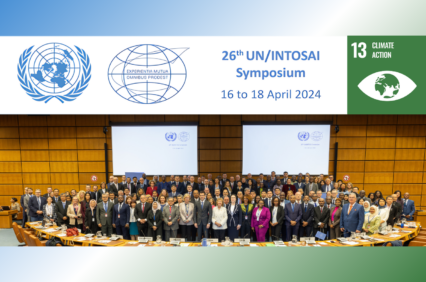
United Nations- INTOSAI Symposium Engages Discussion on the Role of SAIs on Climate Action

Author: Toni Gillich, INTOSAI Journal Secretary, U.S. GAO  The 26th United Nations(UN)/INTOSAI Symposium 2024 took…

ClimateScanner – An Innovative Methodology For SAIs to Monitor Government Action on Climate Change

Authors: Paula Hebling Dutra, Hugo Chudyson Araújo Freire, Carlos Eduardo Lustosa da Costa, Dashiell Velasque…

Climate Change: A Rising Priority for Supreme Audit Institutions

The INTOSAI Working Group on Environmental Auditing (WGEA) has observed an increasing diversity in audits on climate action. In addition to climate change mitigation, Supreme Audit Institutions (SAI) are increasingly auditing climate change adaptation and social aspects. At the same time, developing country SAIs are becoming more engaged. The latest INTOSAI WGEA survey shows that SAIs’ interest in environmental audits and auditing climate action continues to grow. 

The Role of Supreme Audit Institutions in a Changing World

As Auditor General, I have had the privilege of overseeing our national audit office during a period of change and significant challenges. As I reflect on my seven years in office, there are several key themes and lessons learned that I find to be essential for the ongoing development and effectiveness of Supreme Audit Institutions (SAIs) globally.

Transformational Change in Environmental Auditing: Journey of SAI Maldives

From an aerial view, the Maldives appears as a dazzling pearl necklace, with its scattered islands forming intricate atolls in the Indian Ocean. Yet, the true heart of our nation lies beneath the surface—our extensive and vital reef system. Spanning 4,513 square kilometers, these reefs are the seventh largest globally, sustaining a diverse ecosystem of over 1,200 marine species. For our small island nation, these pristine waters, vibrant marine life, and sandy beaches are not just natural treasures but the backbone of our economy. Furthermore, our reefs act as crucial barriers, protecting our low-lying islands—80% of which are less than one meter above sea level—from the ocean’s relentless forces.